A Whole Living System
Most attempts stitch organisations into a network. That is sewing organs together and expecting a body.
What is a system, and what makes one alive instead of just running?
A stitched-together organization and a grown one do the same jobs; only one of them keeps going, and here is the difference.
Why the pieces are designed as one living system rather than a network of separate parts.
A living system grows from a working whole, small, and is then allowed to get bigger. It is not parts stitched together.
Stitched together, or grown whole
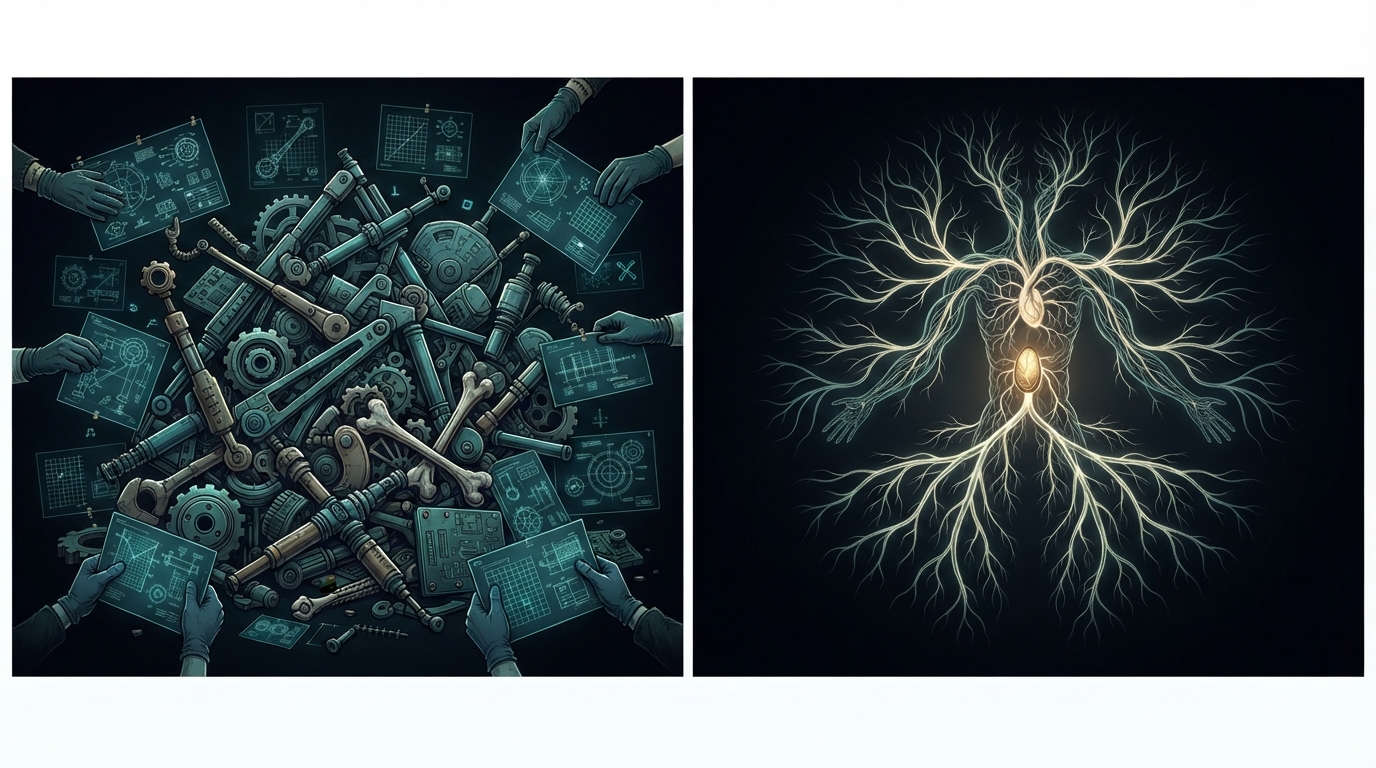
Parts come with their own plans, and the plans do not agree. Someone has to force the fit, and the fit is the only thing holding it together. A living thing starts from one origin instead, so the parts arrive already belonging to each other.
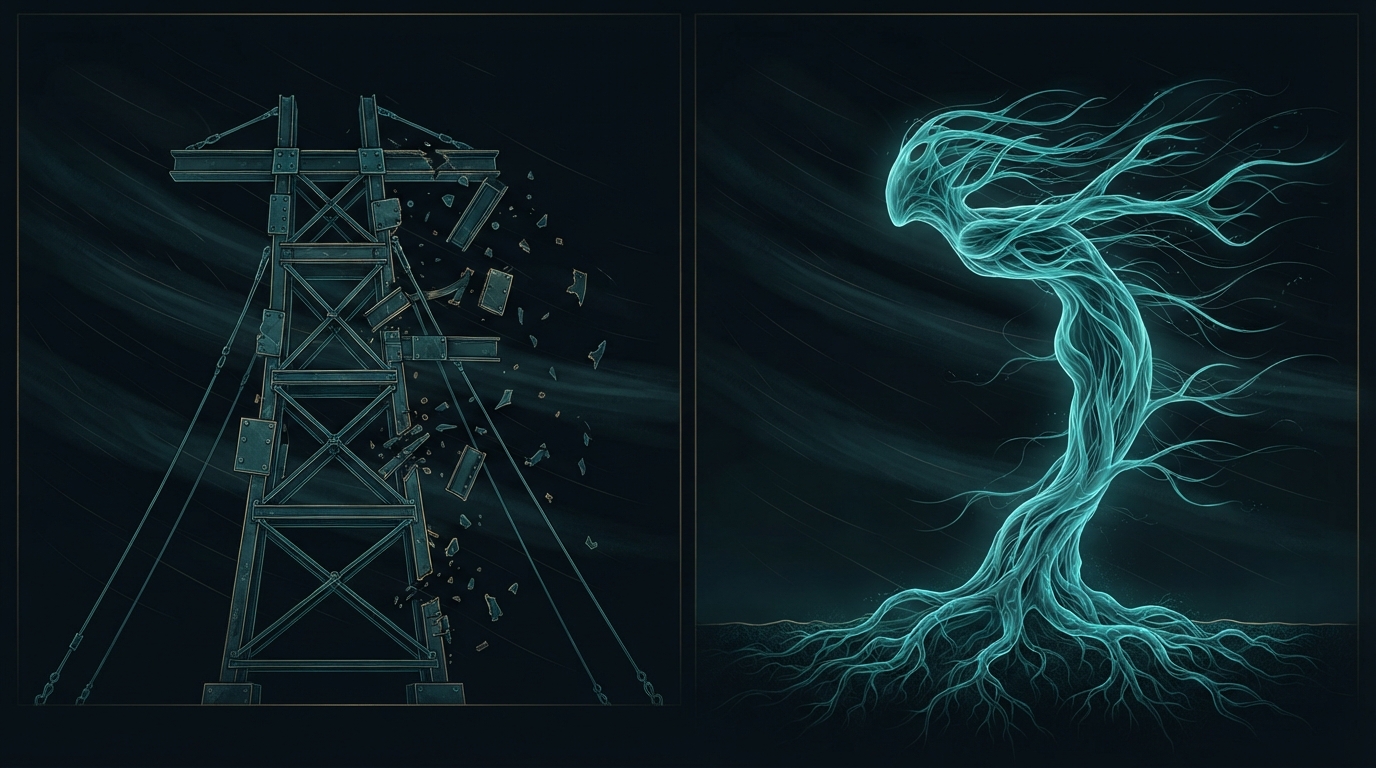
Then the weather comes. The built one holds its shape until its joins give way. The grown one bends into the storm and is changed by it, because it was never assembled in the first place.
How the doors fit into one body
The structure every part shares, so parts can work together without merging.
The unit the whole is made of.
How the body senses a problem and responds without a single head.
How what is needed reaches every part, and nothing pools in one place.
Separate organisms working together without either absorbing the other.
Teal now, turquoise later
Teal is the structural work being built now. Turquoise is the horizon it unlocks. We are building toward it rather than claiming to have reached it.
The living-system functions comparison
The chart
| # | Function |
|---|---|
| 1 | Resource intake |
What a living system needs Bring in raw resource, convert it, hold it appropriately What ETHOS uses Required viable business plan + built to deal in commerce; feeds itself before it optimizes economics What's new vs co-op / nonprofit / corporation Corp feeds itself first (members last); nonprofit lives on a donor drip (starves when the drip stops); co-op earns but distributes out. New: self-sustaining intake baked into certification Co-op Yes it trades for its own living, and that is intake Nonprofit Partly resource does come in, through grants and gifts, so intake depends on someone upstream choosing to give Corporation Yes earning its own way is the thing this form does most reliably ETHOS, by design Yes a workable business plan is required before certification, so it feeds itself before it optimises anything | |
| 2 | Distribution |
What a living system needs Converted resource flows to every part continuously; blockages kill What ETHOS uses Access economy; basic-needs-first → next-steps → expansion; a living shared pool, not a payout What's new vs co-op / nonprofit / corporation Corp distributes upward; co-op splits surplus out and empties the commons. New: flows THROUGH; the commons stays a living pool Co-op Partly wages and a dividend reach members; people working alongside them get neither Nonprofit Partly it pays its people and moves resource to those it serves, and cannot keep that up without a funder Corporation Partly payroll reaches every part; the surplus on top goes up and out ETHOS, by design Yes basic needs, then next steps, then expansion, from a pool that stays in the system | |
| 3 | Sense-making |
What a living system needs Detect signal, integrate to one coherent understanding, route the response What ETHOS uses The ACT process (Agent Coherence Template): one coherent signal, not a vote What's new vs co-op / nonprofit / corporation Others tally votes (the 49% become the opposition) or obey a boss. New: integration, not tally; no outvoted minority to sabotage Co-op Partly one member one vote is a tally, but many co-ops decide by consent in practice Nonprofit No the board carries it, and the board votes Corporation No authority decides; nothing has to be integrated ETHOS, by design Yes every no arrives with a solution, so disagreement is the material | |
| 4 | Culture signalling |
What a living system needs Slow, ambient signals that shape behavior with no memo sent What ETHOS uses The Culture Code: values and agreements internalized at entry; behavior emerges without direction What's new vs co-op / nonprofit / corporation Others push culture top-down (posters, managers) or leave it to personality. New: ambient and structurally embedded; agreement-based, not personality-based Co-op Partly shared ownership sets a real tone, carried by habit and by whoever is in the room Nonprofit Partly the mission draws people who already share it, which does genuine work and is not built in Corporation Partly culture is announced from the top, so it is a broadcast, and it changes with whoever runs the place ETHOS, by design Yes values and agreements are taken on at entry, so behaviour comes out without anyone directing it | |
| 5 | Boundary and identity |
What a living system needs Know what belongs and what does not; turn away the incompatible without attacking healthy parts What ETHOS uses Agreement Fields as a living membrane: you match the field or you don't; remediation before removal What's new vs co-op / nonprofit / corporation Corp boundary = legal/HR; co-op = membership vote. New: compatibility is structural, not adjudicated case by case Co-op Partly membership is a real boundary, decided by a vote rather than by fit Nonprofit No the boundary is employment and the board; nothing asks whether a person matches Corporation No hiring and legal terms ETHOS, by design Yes you match the field or you do not, and repair comes before removal | |
| 6 | Structure |
What a living system needs A load-bearing frame; stable but able to grow What ETHOS uses EcoPlan / GenPlan / SpecPlan + legal and org architecture; a frame that grows through ACT What's new vs co-op / nonprofit / corporation Corp = rigid org chart (snaps under change); startup = no frame (collapses). New: a frame that lengthens; stable adaptability Co-op Yes bylaws and a member structure are load-bearing, and the members can amend them Nonprofit Yes articles, bylaws and a board are built to outlast the people in them Corporation Partly a strong frame that does not bend, so it snaps rather than lengthens ETHOS, by design Yes plans at three levels, each able to change through the decision process | |
| 7 | Execution |
What a living system needs The system actually moves and does work What ETHOS uses Circles execute their own approved SpecPlan; self-directed, no manager pulling the string What's new vs co-op / nonprofit / corporation Corp work fires on a manager's command. New: work fires from within; a body, not a puppet Co-op Yes it runs a real business Nonprofit Yes it delivers, often on very little Corporation Yes this is what the form is best at, and nothing here is in dispute ETHOS, by design Yes circles run their own approved plan, with nobody pulling the string | |
| 8 | Replication |
What a living system needs Copy itself; spawn new wholes carrying the same pattern; scale without losing coherence What ETHOS uses Mitosis: teams split into two complete wholes; the book itself certifies new ETHOS (the pattern) What's new vs co-op / nonprofit / corporation Others onboard individuals or grow by swelling or acquisition. New: growth by division into whole units; neither half diminished Co-op Partly large co-ops do split at a size limit and federate; it is a choice some make, not how the form works Nonprofit No it adds chapters under one centre, so the new part is never whole Corporation No it swells, or it buys ETHOS, by design Yes a team divides into two complete units and neither is diminished | |
| 9 | Clearance and reserves |
What a living system needs Clear what is no longer useful before it turns toxic, while keeping healthy reserves What ETHOS uses No-hoarding economy clears stagnant or captured resource and unresolved tension; keeps living reserves for shocks What's new vs co-op / nonprofit / corporation Corp hoards (retained earnings, empire). New: clears hoarding AND buffers for resilience; clearing is not starving Co-op Partly reserves are required, and in several countries cannot be divided up; nothing clears resource that has gone stagnant Nonprofit Partly an operating reserve is standard practice, clearing is not Corporation Partly reserves are deep and deliberate; hoarding is the strategy, not the fault ETHOS, by design Yes stagnant resource and unresolved tension both get cleared, and a buffer is still kept | |
| 10 | Entry and exit |
What a living system needs A selective boundary that converts things in and out, not a free door What ETHOS uses Structured onboarding and alignment that converts people in (agreement-field entry, coherence confirmation); exit and return are processes What's new vs co-op / nonprofit / corporation Others admit (a list) or gate (an application). Aim: a boundary that transforms, not just filters. Honestly still under development Co-op Partly joining is a real process with a share behind it; it admits rather than converts Nonprofit Partly volunteers and staff are inducted, and nothing about a person changes on the way in Corporation Partly onboarding is thorough, and it is training ETHOS, by design Partly the design asks for a way in that transforms rather than filters, and says plainly this is the one function still being worked out | |
| 11 | Self-regulation |
What a living system needs Monitor itself and correct without external direction What ETHOS uses Self-organized Circles + agreement fields + ACT hold balance; no absent leader as the regulator What's new vs co-op / nonprofit / corporation Others rely on a leader or board as the external thermostat. New: the thermostat is distributed; balance holds with no one at the center Co-op Partly no owner sits above the members, but a board and a manager do, so the regulator is elected rather than absent Nonprofit No the board and the director are the thermostat, and they sit outside the work Corporation No correction comes down the chain ETHOS, by design Yes balance is held by the circles and the agreements, with no centre to remove | |
| 12 | Memory and learning |
What a living system needs Remember, learn from experience, adapt; not static What ETHOS uses Everything written (plans, agreements); boundaries amendable via ACT; the infinite game What's new vs co-op / nonprofit / corporation Others keep memory in heads (walks out) or hand you a fixed rulebook. New: memory that outlives the individual + a built-in amendment process Co-op Yes minutes, bylaws and audited accounts are real memory, and the members can amend what they find Nonprofit Yes filings and board records are permanent, and often public Corporation Partly records are excellent and kept for compliance; what was learned mostly stays in heads and walks out with them ETHOS, by design Yes everything is written, and the boundaries themselves can be amended | |
| 13 | Repair |
What a living system needs Repair damage without external direction; contain it; keep functioning What ETHOS uses The conflict-resolution ladder (L1–6) + role accountability; survives complete member turnover (GenPlan carries the vision) What's new vs co-op / nonprofit / corporation Corp repairs by restructuring and layoffs (trauma); others depend on a founder. New: graduated repair that assumes disruption; the unit regrows around the wound Co-op Partly a grievance process is in most bylaws, and it escalates to a vote or a court rather than repairing Nonprofit No conflict goes to the board or to HR, which is direction from outside the work Corporation No repair is restructuring and removal ETHOS, by design Yes a graduated ladder that assumes disruption, so the unit regrows around the wound | |
| 14 | Exchange with the larger system |
What a living system needs Constant, involuntary exchange with the surroundings; you die from its loss first What ETHOS uses The ETHOS's continuous link to its ecosystem and to Holos: information, energy, legitimacy, belonging to the larger whole it is part of What's new vs co-op / nonprofit / corporation Others can be fully funded yet suffocating, cut off from purpose and environment. New: the unit-to-ecosystem exchange is explicit Co-op Partly real exchange, mostly with the market and the state Nonprofit Partly constant exchange, with funders and government: a larger system, but not a living one Corporation Partly exchange with markets and regulators, both of which it tries to control ETHOS, by design Yes exchange with its ecosystem is named as a function, not left to happen | |
| 15 | Designed endings |
What a living system needs Healthy living systems end their own parts on purpose; a part that will not end is the disease What ETHOS uses Designed graceful death of roles, projects and Circles: sunset clauses, role dissolution, clean endings What's new vs co-op / nonprofit / corporation Others keep zombie committees and roles that never die. New: death is designed in, the twin of replication (#8); birth needs death Co-op No committees and officer roles persist until somebody removes them Nonprofit Partly dissolution is planned from the start and the assets must go on serving the purpose; roles and programs inside it still never end Corporation No winding up is what failure looks like, not what design looks like ETHOS, by design Yes roles, projects and circles are given endings when they are created | |
Open a row for the rest.
Three failure names the design prevents
Capture (a faction stops answering the coherence signal and takes growth for itself) · self-attack (protection mechanisms turn on healthy members: purity spirals, callout culture) · the part that will not end (roles and committees that should close and do not). Josh's "renegade cells / voting is the virus" line stands behind all three.
What's-missing-from-other-models matrix
| What a living system needs | Co-op | Nonprofit | Corporation | ETHOS, by design |
|---|---|---|---|---|
| Resource reaches every part | Partly | Partly | Partly | ✓ |
Co-op Partly wages and a patronage dividend reach members; non-members working alongside them get neither Nonprofit Partly it pays its people and moves resources to those it serves, but cannot keep that flowing without a funder upstream Corporation Partly payroll does reach every part; the surplus on top goes up and out, never back through ETHOS, by design ✓ basic needs first, then next steps, then expansion, from a pool that stays in the system | ||||
| Shared commons you have access to rather than own | Partly | Partly | No | ✓ |
Co-op Partly shared premises, equipment and buying power are real access, and they stop at the edge of the membership Nonprofit Partly libraries, land trusts and tool libraries are commons; most nonprofits are a service, not a commons Corporation No everything held is owned, and access follows ownership ETHOS, by design ✓ the commons is the holding form, and access is the normal way to use it | ||||
| One coherent read of a situation, without voting | Partly | No | No | ✓ |
Co-op Partly one member one vote is still a tally, but many co-ops decide by consent in practice, which is the same family Nonprofit No the board carries the decision and the board votes Corporation No authority decides; nothing has to be integrated ETHOS, by design ✓ every no has to arrive with a solution, so disagreement is the material rather than the obstacle | ||||
| Holds its own balance, with nobody at the top | Partly | No | No | ✓ |
Co-op Partly no owner sits above the members, but a board and a manager do, so the regulator is elected rather than absent Nonprofit No the board and the director are the thermostat and they sit outside the work Corporation No correction comes down the chain ETHOS, by design ✓ balance is held by the circles and the agreements, with no centre to remove | ||||
| Grows by splitting into whole new units | Partly | No | No | ✓ |
Co-op Partly large co-ops do split at a size limit and federate; it is a choice some make, not how the form works Nonprofit No it grows by adding chapters under one centre, so the new part is never whole Corporation No it swells, or it buys ETHOS, by design ✓ a team divides into two complete units and neither is diminished | ||||
| Clears what is stuck, keeps real reserves | Partly | Partly | Partly | ✓ |
Co-op Partly reserves are required, and in several countries cannot be divided up; nothing clears resource that has gone stagnant Nonprofit Partly an operating reserve is standard practice, clearing is not Corporation Partly reserves are deep and deliberate; hoarding is the strategy, not the fault ETHOS, by design ✓ stagnant resource and unresolved tension both get cleared, and a buffer is still kept for shocks | ||||
| Built to keep going, not to be won | Partly | Partly | No | ✓ |
Co-op Partly it lasts and its rules can be amended by the members; its purpose can still be voted away Nonprofit Partly the purpose is locked to outlive anyone, which is the strongest thing about the form Corporation No the form is built toward an exit, and an exit is an ending someone wins ETHOS, by design ✓ nothing in it is designed to be won | ||||
| A boundary of agreement, not of permission | Partly | No | No | ✓ |
Co-op Partly joining means signing up to bylaws, which is an agreement; fit is not what is being tested Nonprofit No you are admitted, employed or granted to, and nothing asks whether you match Corporation No hiring and legal terms, not compatibility ETHOS, by design ✓ you match the field or you do not, and repair comes before removal | ||||
| Constant exchange with the larger system it belongs to | Partly | Partly | Partly | ✓ |
Co-op Partly real exchange, mostly with the market and the state Nonprofit Partly constant exchange, and it is with funders and government: a larger system, but not a living one Corporation Partly exchange with markets and regulators, both of which it tries to control ETHOS, by design ✓ exchange with its ecosystem is named as a function, not left to happen | ||||
| Parts that end on purpose | No | Partly | No | ✓ |
Co-op No committees and officer roles persist until someone removes them Nonprofit Partly dissolution is planned from the start and the assets must go on serving the purpose; roles and programs inside it still never end Corporation No winding up is what failure looks like, not what design looks like ETHOS, by design ✓ roles, projects and circles are given endings when they are created | ||||
Open a row for the reasons.
From OS Compare's file projects/os-compare/living-system-functions-comparison.md, as it stood on 2026-09-22.