ETHOS
An ETHOS is an organization built on written agreements that everyone in it consented to.
How can organizations help build a new society?
By running on written agreements everyone consented to, so no one can take them over.
What an ETHOS is, why it starts with written agreements rather than a boss, and what consent means in practice.
An ETHOS is an organization built on written agreements that everyone in it consented to. Those agreements do the job an owner and a boss do elsewhere.
Four things decided in advance, in the open
Usually decided by whoever has the most standing. In an ETHOS, written down and agreed before anyone needs them.
Where an ETHOS is strongest
Agreed while everyone is still calm. That is the difference between a hard conversation and an ending.
Problems get named early instead of late, because raising one is the process rather than a risk.
Something valuable and a legal door to carry it out through: an ETHOS is built without the door.
People who cannot leave cheaply stop saying what they think. The terms are set at the start.
Every role has a scope, a review date and a named way to hand it back.
NEOS, an ETHOS and OmniOne
NEOS is the design, an ETHOS is an organization built to it, and OmniOne is one group of them working together. More than one ecosystem can run on it.
The one difference
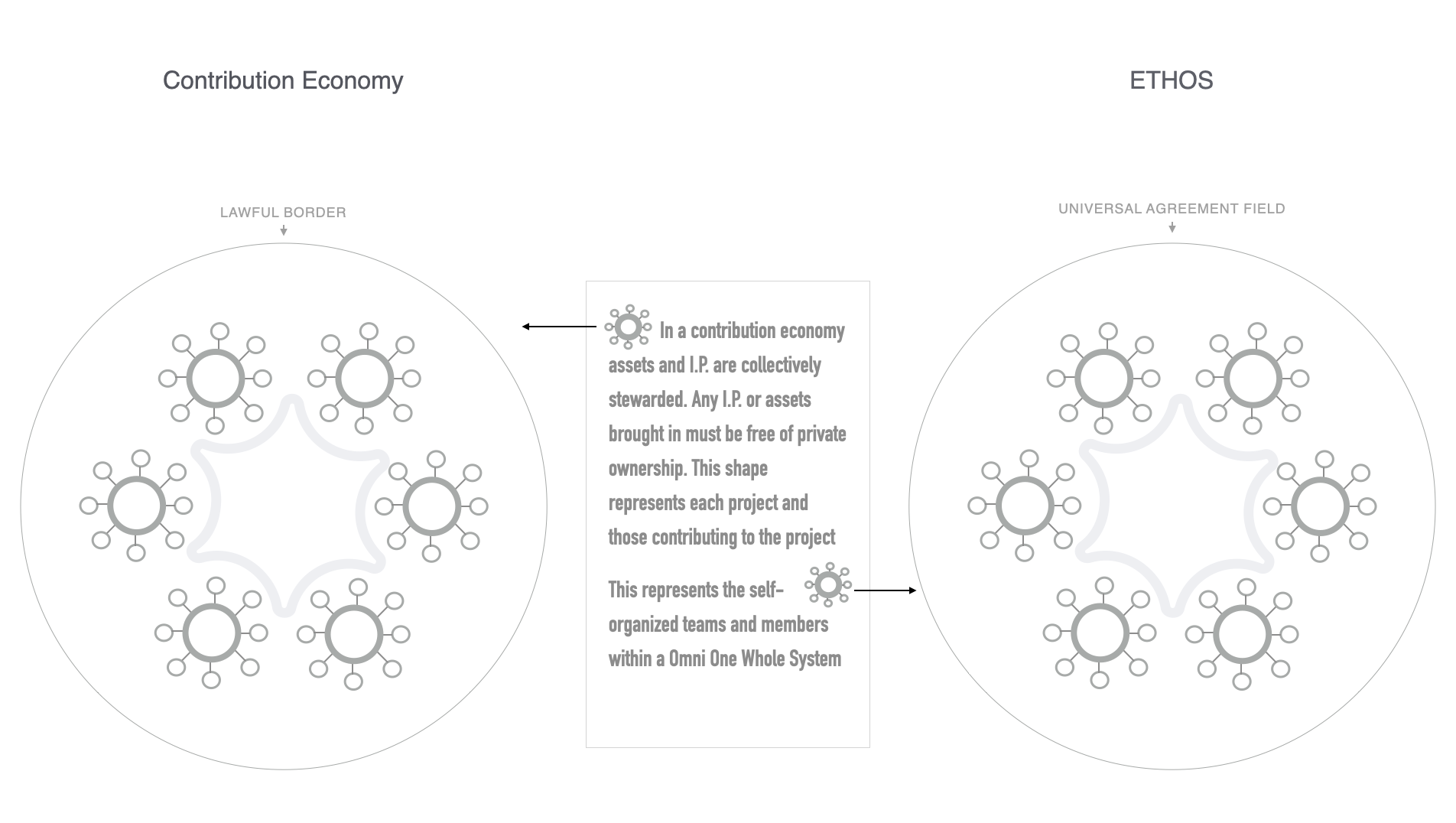
Same cells on both sides. A lawful border on one, an agreement field on the other.
The ETHOS Book
The whole thing, taught end to end rather than summarised. Being written now.
Where it comes from
An ETHOS is what the Teal Paradigm looks like once it has a structure to live in. The Teal work named how organisations could operate when nobody rules them, and it described that change accurately enough that people recognised themselves in it. What it left open was the machinery: who owns what, where the money goes, and what holds when someone wants to take the thing over. An ETHOS is that machinery, built on the same understanding.
from system/explanations/what-an-ethos-is.md voice, ETHOS Book, 2026-09-20
Sociocracy, holacracy and an ETHOS
The one-line version
Sociocracy is a way of deciding and organizing together (consent + circles). Holacracy is a packaged operating system for a company (a rulebook that reassigns authority from managers to roles). ETHOS is a whole living system (it carries governance, plus economics, ownership, culture, the inner shift, and an anti-capture boundary that the other two do not touch).
The chart
| Dimension | Sociocracy (SoFA / Ted Rau) | Holacracy (HolacracyOne) | ETHOS (OmniOne) |
|---|---|---|---|
| What it is | A decision + organizing method | A full operating system for one company | A whole living system: governance + economics + culture + ownership + inner shift |
| Scope it claims | How a group decides and structures itself | How a whole company runs, day to day | The organization and its economy, its ecosystem, and the person building it |
| Core decision method | Consent: a decision passes when no one has an objection tied to the aim | Integrative Decision-Making: a proposal passes unless an objection meets tested validity criteria | ACT: sense-making that sorts critical / emergent / preference, asks for a solution with every no, and bars coercion |
| What an objection is | A reason the proposal conflicts with the circle's aim; celebrated, then integrated | A reason the proposal causes harm, tested against strict criteria by the facilitator | A surfaced tension resolved by sense-making; the objector helps carry the fix |
| Where authority lives | In the aims + domains, held by consent | In the written Constitution (the company adopts it and power shifts to it) | In the agreement field, nested Universal to Ecosystem to ETHOS to Space; authority is in the agreements, not people |
| Structure | Nested circles, 4 to 8 people, each autonomous in its domain | Nested circles of roles, each role with purpose, domain, accountabilities | Circles with domains; the holon test; growth by mitosis (a circle divides when whole) |
| How circles connect | Double-linking: a leader and a delegate sit in both circles and both consent upward | Lead Link (assigned from above) plus Rep Link (elected from below) | Through the agreement field + ACT for anything binding across a circle (no standing delegate role, see the gap list) |
| Leadership | A circle leader, appointed by the parent circle by consent | Lead Link, assigned by the super-circle, assigns roles | No boss; purpose coordinates; every role is revocable and returns to the pool on a six-month review |
| Filling roles | The selection process: nominations, a change round, then consent to a candidate and a term (no vote) | Integrative election for facilitator, secretary, and Rep Link | Consent to a role, revocable, reviewed at six months (the selection procedure itself is thin, see the gap list) |
| Meetings | A set format: check-in, admin, agenda by consent, rounds, check-out | Governance meetings + tactical meetings, tightly scripted | ACT for binding decisions; a team's own meeting practices live in the Culture Code, not fixed in the book |
| Conflict + interpersonal repair | Blame-free feedback; NVC suggested as a complement; performance and circle reviews | Out of scope by design (Holacracy governs roles, not the people) | Solutionary Culture: a repair ladder, coach training, pre-selected coaches, a red-flag freeze, an accountability ladder |
| The inner / personal dimension | Light: the human check-in | Explicitly excluded (role, not soul) | A whole chapter: self-responsibility, the golden rule, non-force, finding your why |
| Economics + ownership | Not addressed (governance only) | Not addressed (runs inside a conventional company; shareholders still own it) | A closed-loop economy: no owner, surplus to the commons, a pay ceiling, a basic-needs floor |
| Anti-capture | None stated | The Constitution shifts power from the CEO, but capital still owns the company and can revoke it | Structural: capital buys no governance, a legitimate fork always exists, certification is earned and revocable |
| Review + adaptation | Lead-do-measure; every policy carries a term-end; aim reviews | Continuous governance; tensions processed as they arise | Adaptive feedback plus a binding yearly review for drift, and the six-month role review |
| Ecosystem beyond one org | Single organization | Single organization | A layer above the org: shared agreements, interoperability, a commons, other ETHOS |
| Openness / licensing | Open, Creative Commons, nonprofit-stewarded (SoFA) | Constitution is open, but the brand and certification are trademark-licensed | Open: the book is the credential; certification gates ecosystem access, not the ideas |
The ETHOS column describes a design being built; sociocracy and holacracy are in real-world use. The numbers here are estimates, not measurements. They come from ETHOS Book's file projects/ethos-book/sociocracy-holacracy-ethos-comparison.md, as it stood on 2026-09-16. Deeper analysis could change these numbers.
from system/explanations/what-an-ethos-is.md, v1.2, 2026-09-15 (ETHOS Book)